
Posted by: Jack Weatherly in Economic Development, MBJ FEATURE, NEWS August 4, 2017 By JACK WEATHERLY
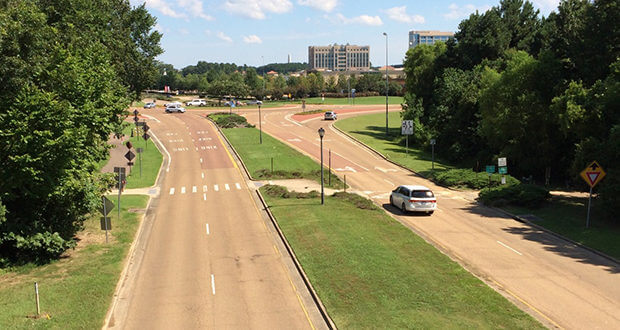
Traffic goes with growth. Ridgeland’s population has more than doubled since 1990 – reaching nearly 25,000 –while the Madison County’s estimated 2016 population likewise more than doubled in that period, hitting 105,000. And traffic drives much of the waking hours of government and civic leaders in the county. The population growth “has put a major strain on the existing roadways and intersections and has resulted in traffic congestion on many of the major routes,” according to a study last year for county government by Neel-Schaffer engineering. The Nissan manufacturing plant, which started production in 2003, has been the primary reason, the study stated. Dick Hall, Mississippi Department of Transportation Central District commissioner, told the Mississippi Business Journal last year that “we have to spend where the highest traffic is,” and that includes the Jackson metro area with emphasis on Madison County. It should come as no surprise that the city of Ridgeland is looking for a better way to address the problem. And it is hardly alone across the nation. “Big data technologies are beginning to transform the way cities work,” an April 16 Wall Street Journal article titled “The Rise of the Smart City” stated. Ridgeland announced at the Mississippi Municipal League annual conference, which was held last week in Biloxi, that it is teaming with C Spire to do a two-month test on “smart technology.” The first-ever such trial in Mississippi will be paid for the Ridgeland-based telecom, and, should it prove to the city’s liking, Ridgeland would, of course, pay for the service. Mayor Gene McGee said in a prepared statement that “a smart city can optimize traffic flow and commerce on congested roads and arterial streets through data analytics and connected signal sensors, saving time, fuel and operating costs.” Dave Miller, C Spire spokesman, said the company, which is using Nokia technology, has not set a price. The smart technology also will address street lighting in addition to traffic signals, Miller said in an interview. The key to the technology is what is called “the Internet of Things,” meaning the ability of one device to communicate with another without human intervention. Part of the population and traffic growth is because of a shift from Jackson to Ridgeland and the rest of the county, which has become the wealthiest in per capita terms in the state. One area of concern is the Highland Colony Parkway, the north-south boulevard that includes upscale office parks and commercial development, including the Renaissance at Highland Colony. Proposed expansion of that open-air, village-style mall by a 45-acre satellite has been a source of bitter debate and legal battle for several years between homeowners allied against developers and the city. In a word, Costco. Opponents of the expansion contend that the Costco Wholesale would change the tenor of the area, and expose it to a higher degree of traffic, including large trucks making deliveries to the store. The specter of County Line Road has been thrown about by those who are fearful of the development. County Line, which divides Jackson and Ridgeland and historically has been the dominant retail corridor in the metro area, is the local poster child of bad traffic. “County Line!” has been the war cry. But the developers, led by Andrew Mattiace, have downplayed such concerns, saying that delivery trucks would be present in off hours. Aside from lawsuits, 2,400 residents signed a petition in 2015 opposing the Costco store, contending it would double the traffic and is “entirely incompatible” with nearby neighborhoods. Some have stated that the roundabout that connects Colony Parkway and Old Agency Road could be lost. The company has stated that the large trucks would make deliveries in off hours. The Ridgeland-C Spire trial run will address overall traffic flow in the city, Miller said. Miller said that it has not been decided where the traffic tests will be conducted. But to illustrate the flip side of traffic management, Miller suggested one scenario. A red light might be overdoing its purpose at times, such as when there is little or no traffic at an intersection in the middle of the night and a lone vehicle might be needlessly held up. Additionally, street lights would be equipped to come on and go off given the degree of daylight. The Wall Street Journal recently published a story called “The Rise of the Smart City,” in which applications of such technology has been used for wide number of reasons. Mobile, Ala., for instance, made an inventory of 1,200 blighted properties in eight days by using Instagram, and later cross-referenced the list with tax records and out-of-state ownership to compile a “blight index,” according to The Journal. C Spire serves Mobile and other parts of Alabama, Miller said. And it provides cloud storage technology in New Orleans, another city cited in the article inThe Journal. It offers wireless service in the Memphis area and the Florida Panhandle. “We’re ready . . . to talk with any cities, counties or municipalities that are serious . . . about [solutions] that are applicable to them,” Miller said.
